Carrlee, Ellen; "Top 13 reasons why we don't use leather dressings at the ASM", Alaska State Museums Bulletin 58 (2012) 1-15
URL / PDF
22/02/2013
"Marcel Duchamp's Boîtes-en-valise: collaboration and conservation" by Campbell at al (2012)
Campbell, Brenna; Lévèque, Élodie; Jue, Erin; “Marcel Duchamp's
Boîtes-en-valise: collaboration and
conservation”, Studies in Conservation 57, Supplement 1 (2012) 52-60
Abstract:
Between 1941 and 1968, Marcel Duchamp produced a series of roughly
300 boxes, or Boîtes, containing, in his words, ‘everything important that I
have done’ (Sargeant, W. 1952. Dada's Daddy: A New Tribute is Paid to Duchamp,
Pioneer of Nonsense and Nihilism. Life, 32(17): 102). Over the course of 30
years and seven editions, Duchamp and his assistants filled these ‘portable
museums’ with miniature reproductions of his most significant works. The
materials used included leather, paper, cloth, metal, glass, ceramic, cellulose
acetate, gouache, varnish, and wood. The variety of the constituent materials,
and the complex physical and conceptual ways in which they interact, make
conservation treatment of the Boîtes unusually challenging. The conservator
must consider both the condition of the specific Boîte being treated and its
relationship to the dozens of other Boîtes still in existence. After an
overview of the history and manufacture of Duchamp's miniature museum, the
results of a pilot survey of the condition of 19 Boîtes will be presented, and
treatment solutions to the most common condition problems proposed.

15/02/2013
The boot and shoe trades in London and Paris in the long eighteenth century by Riello (2002)
Riello, Giorgio; The boot and shoe trades in London and Paris in the long eighteenth century, Doctoral thesis, University of London (2002)
Abstract:
This thesis examines the evolution of pre-industrial shoemaking in London and Paris between the 1680s and the 1850s, treating this period as a whole. The relevance of these two cities is based on the international role they played in the clothing sector. Both cities not only dominated national manufacturing, but were able to influence the standard of production and European fashion. My research aims to construct a comparison of the two productive centres leading to a contrasting study of pre-conditions, strategies and influences in shoemaking. The starting point is a broad view of the 'regulative framework' of the sector: the importance of the raw material market (leather and textiles) and the role of guilds, their organisation and their control of the market. A chapter dedicated to consumption explores the relationship between the London shoe market and the influence of Parisian fashion. The interest in consumption is motivated also by the debate on what economic and social historians consider to be 'mass production' as the other face of 'mass consumption'. A chapter dedicated to retailing tries to link consumption to production. My research is then focused on a study of the organisation of production in the two cities. Different typologies of producers are related to different consumer choices showing how new consumer practices and retailing facilities re-shaped production. Finally the link between fashion changes and marketing techniques (for instance the use of sizes, brands or the distinction between right and left shoes) is a fruitful field of comparative research. The last two chapters of the thesis focus on the first half of the nineteenth century. Particular attention is dedicated to the importation into England of large quantities of women's shoes from France. The crisis that the London sector faced after 1815 explains a series of changes in the market and in the role played by the British metropolis in directing the sector. Very different appears to be the Parisian case, where provincial producers flourished only after the mechanisation of the sector. By the 1850s mechanisation meant the beginning of a new phase in the trade.
08/02/2013
01/02/2013
"On tanning and leather-dressing" by Aikin (1833-1834)
Aikin, A.; “On tanning and leather-dressing”, Transactions of the Society, Instituted at London, for the Encouragement of Arts, Manufactures, and Commerce 50, Part I (1833-1834) 192-214
URL (JSTOR)
25/01/2013
Rapport au Comité de salut public sur les nouveaux moyens de tanner les cuirs, proposés par le citoyen Armand Seguin (1794-1795)
Seguin, Armand; Rapport au Comité de salut public sur les nouveaux moyens de tanner les cuirs, proposés par le citoyen Armand Seguin (1794-1795)
URL 1 (Gallica)
URL 2 (Gallica)
URL 1 (Gallica)
URL 2 (Gallica)
18/01/2013
"O comércio de "couro dourado"/guadameci entre Córdova e Lisboa: um contrato de venda de 1525" por Pereira (2013)
Pereira, Franklin; “O comércio de "couro dourado"/guadameci entre Córdova e Lisboa: um contrato de venda de 1525”, Medievalista [Em linha]13 (Janeiro - Junho 2013).
Resumo:
"O comércio de "couro dourado"/guadameci entre Córdova e Lisboa: um contrato de venda de 1525" incide sobre um documento de importações entre um guadamecileiro de Lisboa, trabalhando para a corte, e um pintor de Córdova; a lista inclui frontais de altar, cobertas de parede e coxins. Além de comentar o contrato, o autor refere os usos do guadameci nos dois países ibéricos pós-Reconquista como parte das modas mudéjares do século XV-XVI.
Abstract:
"The trade of gilt leather/guadameci between Córdoba and Lisbon: a contract from 1525" deals with a document of imports between a gilt leather maker from Lisbon, working for the court, and a painter from Córdoba; the list includes altar fronts, wall hangings and cushions. Besides commenting such contract, the author refers the uses of gilt leather in both Iberian countries coming out of the Reconquest as part of the mudejar fashions of the 15th-16th centuries.
11/01/2013
"Brief directions how to tan leather according to the new invention of the honourable Charles Howard of Norfolk..." by Howard (1674)
Howard, Charles; “Brief directions how to tan leather according to the new invention of the honourable Charles Howard of Norfolk, experimented and approved of by divers of the principal tanners using Leaden-Hall market”, Philosophical Transactions 9(101-111) (1674) 93-96
doi: 10.1098/rstl.1674.0025 / PDF/ JSTOR
28/12/2012
"The Tanners of Wrotham Manor 1400-1600" by Semple (2006)
Semple, Jayne; “The Tanners of Wrotham Manor 1400-1600”, Archaeologia Cantiana 126 (2006) 1-25
URL
URL
Abstract:
This paper describes the trade of tanning and the lives of the tanners in the manor of Wrotham in the fifteenth and sixteenth centuries. The manor stretched from the North Downs along the valley of the river Bourne into the Weald and was divided into six boroughs. Tanning took place in four of them; Nepicar, Winfield, Hale and Roughway.

07/12/2012
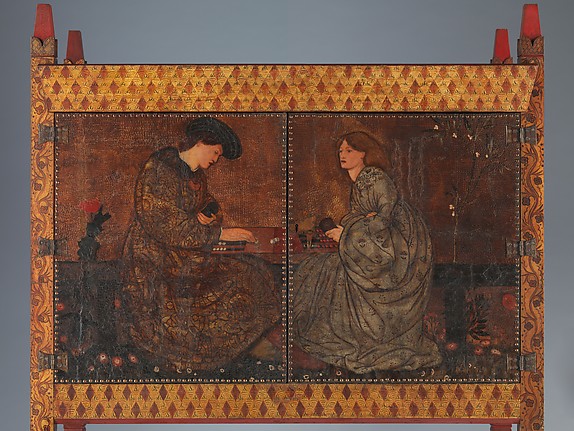
Cabinet with painted leather (doors), Philip Webb and Edward Burne-Jones,1861, The MET Museum of Art

"Philip Webb and Sir Edward Burne-Jones: Cabinet (26.54)". In Heilbrunn Timeline of Art History. New York: The Metropolitan Museum of Art, 2000–. http://www.metmuseum.org/toah/works-of-art/26.54 (October 2006)
01/12/2012
“Las encuadernaciones mudéjares de lacerías con motivos centrales en la Catedral de Toledo” por Carpallo Bautista y Burgos Bordonau (2012)
Carpallo Bautista, A.; Burgos Bordonau, E.; “Las encuadernaciones mudéjares de lacerías con motivos centrales en la Catedral de Toledo”, Anales de Documentación 15(1) (2012) 1-30
DOI:10.6018/analesdoc.15.1.138811 / PDFResumen:
Dentro de la historia de la encuadernación española destaca el florecimiento del estilo mudéjar entre los siglos XIII y XVI, sobre todo en la península ibérica, sobresaliendo los trabajos realizados en algunas ciudades como Toledo. La Biblioteca Capitular de la Catedral de Toledo dispone uno de los grupos más importantes de España, cuantitativa y cualitativamente, aunque su estado de conservación no es el más adecuado en muchos de los ejemplares. El presente trabajo pretende estudiar y analizar los diferentes tipos de encuadernaciones mudéjares con lacerías, tipo de decoración muy propio de ciudades como Toledo, Salamanca y Barcelona. Se han estudiado las estructuras decorativas y los elementos artísticos empleados, las técnicas de decoración y de construcción, así como los materiales utilizados en la elaboración, con lo que hemos podido establecer el origen o procedencia de cada encuadernación en función de la estructura decorativa, de los motivos decorativos individuales, de las filigranas de las guardas originales y del tipo de cabezadas.
Abstract:
The Mudejar style between the thirteenth and sixteenth centuries in the Iberian Peninsula is specially remarkable, within the history of the Spanish bookbinding, outstanding some of the works done in the city of Toledo. The Capitular Library of Toledo’s Cathedral has one of the most important collections qualitatively and quantitatively speaking, though its state of preservation is not the best one in many of the items. This work pretends to study and analize the different kinds of mudéjar bookbindings with interlaces, a typical style of decoration of cities like Toledo, Salamanca and Barcelona. A study of the decorative structures, artistic elements, tecniques of decoration and construction has been done as well as the materials used for their making. With all these elements we have been able to establish the origin of each bookbinding according to its decorative structure, the individual decorative motifs, the watermark of the original flyleaves and the kind of tops.
23/11/2012
"Identification of a white substance on 20th century leather bindings" by Pemberton and Nel (2008)
Pemberton, Briony; Nel, Petronella; "Identification of a white substance on 20th century leather bindings", AICCM Bulletin 31 (2008) 28-35
PDFAbstract:
The aims of this investigation were to identify a white substance visible on the spines of leather-bound volumes titled Victorian Law Reports and to address any issues of concern. Initially, it was thought that it was a mold outbreak. However, preliminary examination using visual and microscopic methods ruled this out. An analytical path involving environmental scanning electron microscopy with energy dispersive spectroscopy (SEM-EDS), microchemical spot testing, and Fourier transform infrared (FTIR) spectroscopy determined that the white substance was composed of one or more fatty acids and possibly their respective calcium salts. In addition, this investigation provides a review of the available literature and an analytical path for identifying white bloom on leather-bound volumes.
16/11/2012
Bookbinding in England and France by Fletcher (1897)

Fletcher, William Younger; Bookbinding in England and France, Seeley & Co., London (1897)
URL (Internet Archive)
14/11/2012
Arte della Legatura a Brera, Biblioteca Nazionale Braidense, Milano
Bookbinding
Arte della Legatura a Brera
Mostra virtuale - versione webURL
Il sito è aperto dal 12 maggio 2002. Risultano consultabili le immagini di tutte le sezioni, ma le schede in lingua inglese sono disponibili solo in versione ridotta. Sono stati inseriti anche alcuni testi, tratti dal catalogo della mostra "Arte della legatura a Brera" e dai pannelli espositivi utilizzati per la stessa esposizione.
Oltre a una galleria d'immagini, con relativa scheda descrittiva, il sito potrà ospitare contributi, notizie, segnalazioni, attinenti alla storia e alle tecniche della legatura d'arte. La mostra Arte della legatura a Brera, in cui sono stati esposti 110 esemplari di legature italiane e di altre aree europee del Quattrocento e Cinquecento, oltre a 10 legature della Bibliotheca Colbertina possedute dalla Braidense e a vari strumenti e materiali utilizzati nell'arte della legatura, si è conclusa il 22 giugno 2002.
Oltre a una galleria d'immagini, con relativa scheda descrittiva, il sito potrà ospitare contributi, notizie, segnalazioni, attinenti alla storia e alle tecniche della legatura d'arte. La mostra Arte della legatura a Brera, in cui sono stati esposti 110 esemplari di legature italiane e di altre aree europee del Quattrocento e Cinquecento, oltre a 10 legature della Bibliotheca Colbertina possedute dalla Braidense e a vari strumenti e materiali utilizzati nell'arte della legatura, si è conclusa il 22 giugno 2002.
English version: Decorative bookbindings at the Brera (URL)
This website was created on May 12, 2002. Some texts from the exhibition catalogue, Arte della legatura a Brera, and the information panels on display at the Brera event are available for consultation on this website. An English version of all this was created, with reduced descriptive texts. Alongside a Gallery of captioned image files illustrating the Library's collections, this website will include, in time, contributions, reports, hints and tips, suggestions where a history and the techniques of decorative bookbinding are concerned. The exhibition, "The Art of Binding Books Through the 15th and 16th Centuries" housed 110 bindings from Italy and other European countries, along with 10 bindings from the Bibliotheca Colbertina and a host of instruments, tools and materials used in the art of binding books.
Deutsche Version: Einbände in Brera (URL)
Version française: Reliures d'art à Brera (URL)
19/10/2012
“The conservation of nineteenth-century leather-covered willow baskets from Franconia/Bavaria” by Kotonski (2012)
Kotonski, Verena; “The conservation of nineteenth-century leather-covered willow baskets from Franconia/Bavaria”, Journal of the Institute of Conservation 35(1) (2012) 77-91
DOI:10.1080/19455224.2012.681292 (restricted access)
Abstract:
An unusual feature of nineteenth-century leather-covered baskets from Franconia (Bavaria) is the combination of materials used in their manufacture: willow skein basketry, leather and coloured parchment together with decoration, such as metal thread embroidery, thin leather straps and quills. This article presents the results of the detailed investigation into the technology and materials of four baskets from the folk art collection of the Germanisches Nationalmuseum in Nuremberg. The inseparable nature of this combination of materials, once constructed, makes the conservation of this type of basketry especially challenging. The range of treatment options evaluated is discussed in detail as well as the constraints imposed by the composite nature of the baskets and by conflicting ethical considerations. The treatment strategy that was eventually decided upon reflected a constructive compromise between opposing needs.
Résumé:
“La conservation de paniers en osier recouverts de cuir du dix-neuvième siècle de la Franconie / Bavière”
Une caractéristique inhabituelle des paniers recouverts de cuir du XIXe siècle de Franconie (Bavière) est la combinaison des matériaux utilisés dans leur fabrication: la vannerie avec des écheveaux de saule, du cuir et du parchemin de couleur avec des décorations telles que des broderies de fil de métal, des lanières de cuir et des plumes. Cet article présente les résultats d'une enquête détaillée sur la technologie et les matériaux de quatre paniers de la collection d'art folklorique du musée national germanique de Nuremberg. Le caractère indissociable de cette combinaison de matériaux, une fois assemblés, rend la conservation de ce type de vannerie particulièrement difficile. La gamme des options de traitements étudiés est présentée en détail de même que les contraintes imposées à la fois par la nature composite des paniers et par des considérations éthiques contradictoires. La stratégie de traitement qui a finalement été décidée reflète un compromis constructif entre des besoins opposés.
Zusammenfassung:
,,Die Konservierung/Restaurierung lederbezogener Weidenkörbe aus Franken/Bayern des 19.Jahrhunderts“
Ein ungewöhnliches Merkmal der lederbezogenen Körbe aus dem Franken des 19. Jhds. ist die Kombination von Materialien, die bei ihrer Herstellung eingesetzt werden: Weidenstrangflechtwerk, Leder und gefärbtes Pergament in Kombination mit einer Dekoration aus Metallfadenstickerei, dünnen Lederstreifen und Kielen. Dieser Artikel beschreibt die Ergebnisse einer detaillierten Untersuchung der Techniken und Materialien vierer Körbe in der Sammlung Volkskunst am Germanischen Nationalmuseum in Nürnberg. Die Konservierung bzw Restaurierung wird durch die Kombination von Materialien zu einer großen Herausforderung. Eine Reihe von Behandlungsmaßnahmen werden evaluiert und diskutiert, sowie die Einschränkungen, die sich aus der Materialkombination und aus sich widersprechenden ethischen Fragestellungen ergeben. Die Behandlungsstrategie, die schließlich gewählt wurde, reflektiert einen konstruktiven Kompromiss zwischen diesen verschiedenen Parametern.
Resumen:
“La conservación de cestas de mimbre del siglo XIX cubiertas de cuero y provenientes de Franconia/Bavaria”
Una característica inusual de la cestería del siglo XIX cubiertas de cuero y proveniente de Franconia/Bavaria es la combinación de materiales utilizados en su fabricación: la cesta de madeja de sauce, el cuero y el pergamino coloreado, junto con decoraciones como bordados con hilos de metal, tiras finas de cuero y el cañón de las plumas. Este artículo presenta los resultados de una minuciosa investigación sobre la tecnología y los materiales de cuatro cestas de la colección de arte popular del Museo Nacional Germánico de Nuremberg. La naturaleza inseparable de esta combinación de materiales, una vez construida, hace la conservación de este tipo de cestería especialmente compleja. Se discuten en detalle el rango de opciones de tratamiento y se discuten también las limitaciones impuestas por la naturaleza compuesta de las cestas y las consideraciones éticas que entran en conflicto. La estrategia de tratamiento que finalmente se decidió, reflejó un compromiso constructivo entre necesidades opuestas.
12/10/2012
Introduction à l’histoire de la reliure française: XVe-XVIIIe siècles par Toulet (1973)
Toulet, Jean; Introduction à l’histoire de la reliure française: XVe-XVIIIe siècles, Bibliothèque Nationale, Paris (1973)

28/09/2012
Cuir doré hangings in the Royal Ontario Museum by Cselenyi (1973)
Ladislav Cselenyi; Cuir doré hangings in the Royal Ontario Museum, Toronto (1973)
URL (Internet Archive)
URL (Internet Archive)
From the text:
Like stone, wood, textile, metal, glass and other substances, leather has from time immemorial been used as a ground for painting. Such paintings are not to be confused with cuir doré, which usually consists of gilt leather pieces (or carrets) decorated by embossing, punching and painting.
The Royal Ontario Museum has acquired two important cuir dore wall hangings, the larger (PI. 1) 518.3 x 274.4 cm., the smaller (PI. 2) 265.5x266.8 cm. Mr. Heribert Hickl-Szabo, Curator of the European Department, discovered them in the possession of the Lindpaintner' family, from whom the ROM acquired them.
Subscribe to:
Posts (Atom)